ADA Certified Portable Toilets: Federal Ease Of Access Rules for Rentals
When individuals search for an ada compliant portable bathroom, they are normally attempting to resolve a useful trouble under time stress. A school is preparing a field day. A city is setting up a weekend celebration. A church is organizing a charity event on open ground without permanent bathrooms close by. An exclusive location is adding short-lived facilities for a group bigger than its building can take care of. In each of those circumstances, ease of access is not an optional upgrade or a great added. It is part of giving toilet gain access to in a way that does not leave disabled guests, employees, or participants standing outside without functional option.
That is where the government guidelines matter, and where several rental decisions fail. The most significant blunders are hardly ever dramatic. More frequently, somebody orders a basic bank of portable units, assumes one bigger unit someplace on site will certainly cover the demand, then positions it on grass, crushed rock, or a sloped side that makes it tough or difficult to use. Theoretically, the order might look penalty. In the real world, it stops working the person that requires it.
The regulating government requirement in the United States is the 2010 ADA Criteria for Accessible Design, as translated by the united state Gain Access To Board and the Department of Justice. For short-term mobile commode setups, those requirements are not abstract. They form the amount of obtainable units are required, how they should be recognized, and whether people can really get to and make use of them.
The rule that addresses the first question most occupants ask
The initial concern is generally straightforward: the amount of obtainable systems do we need?
For collections of portable single-user bathroom systems, at least 5 percent of the devices in each collection have to come. The Gain access to Board has actually made clear that this uses also at short-lived occasions. That point issues since lots of people still think momentary methods unwinded. It does not.
If you are leasing a financial institution of mobile commodes for an event, the available matter is connected to the cluster itself. The policy is not pleased by stating there is an easily accessible toilet elsewhere on the residential or commercial property if the mobile bathroom cluster individuals are really making use of does not include the required easily accessible unit or systems. The collection is the appropriate setup.
In day-to-day preparation, this is where an ada portable toilet rental order needs more thought than a basic head count. Occasion planners typically concentrate on overall participants and solution intervals, which are necessary for cleanliness, but government access regulations develop a separate demand. Even if the common devices seem appropriate for group volume, the accessible unit count still has to be addressed.
This is also where terminology can muddy the discussion. Suppliers, organizers, and venues might utilize expressions like ada available mobile bathroom, ada mobile restroom, ada handicap available portable bathroom, or ada compliant available mobile toilets. The labels vary. What issues is whether the system and its placement in fact please the applicable federal accessibility standards.
Bigger is not the like compliant
A remarkably common misconception is that a bigger portable toilet automatically certifies as available. In practice, dimension alone does not answer the question.
The mobile easily accessible units need to fulfill toilet-room technological requirements. That includes fixture clearances, transforming space, door steering clearances, and applicable grab-bar and water-closet clearance regulations. Those are useful design needs, not marketing language. An unit can be roomier than a conventional portable commode and still miss what the requirements require.
That distinction issues during buying. If a supplier uses what sounds like a larger family, a transforming system, or an extra-large portable toilet, the renter must not assume it is an ada compliant portable bathroom unless the supplier is specifically representing it as conference ADA requirements. The same opts for casual shorthand such as "wheelchair device" or "obtainable style system." Those expressions might be made use of freely in the area. The government criterion is not loose.
People that have never ever had to think about maneuvering clearances frequently envision ease of access as a single concern of door width. Actual use is a lot more complex. An individual may need sufficient space to go into, shut the door, turn, placement near the toilet, and utilize grab bars securely. If one of those actions breaks down, the restroom is not meaningfully accessible.
Placement can make a certified system unusable
I have actually seen rental arrangements where the appropriate system was gotten and the incorrect ground beat the entire effort. This is one of the most irritating failures since it is so avoidable.
Accessible mobile bathroom units should have an obtainable route and entryway. If ramps or landings are needed, they have to abide by the ADA technical requirements. That implies compliance does not quit at the system covering itself. The path to the unit matters. The entrance problems issue. The surrounding surface area and slope can matter in an extremely functional way.
An ada-compliant portable bathroom placed at the far edge of a sloppy area might check a box in an agreement but still be pointless to many individuals. The same holds true for a system placed where wheel web traffic penetrates soft ground, where a threshold problem is unpleasant, or where the only technique forces a person with a busy solution area. Federal availability is not just about the presence of the unit. It is about accessibility to it.
This is one reason skilled website organizers walk the design prior to shipment, not after. They think about arrival, flow, and what the washroom experience will seem like for a person making use of a mobility device or various other flexibility aid. They likewise consider climate. A course that appears appropriate on a completely dry setup day can turn into a trouble after rain, particularly on momentary event sites.
For occupants, the most safe behavior is to talk about positioning early, not as a final decrease instruction. If there are multiple commode financial institutions throughout a building, each cluster should be reviewed, not simply the total order quantity.
Identification becomes part of the guideline, not simply a courtesy
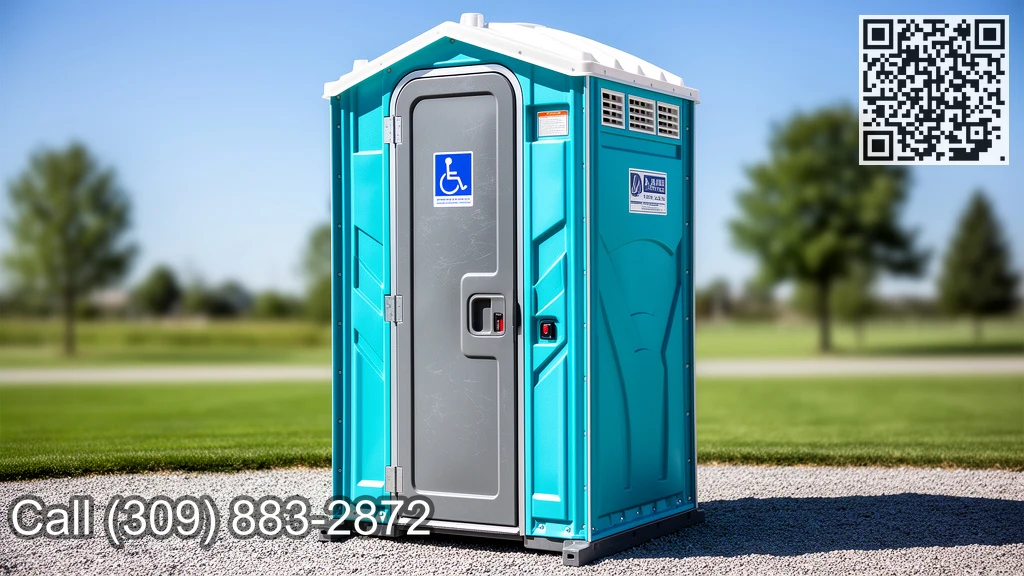
Accessible mobile bathroom units should be related to the International Icon of Access. That demand might appear minor compared with route and clearance concerns, but it offers an actual function.
People must not need to presume which device is the easily accessible one. At crowded events, complication wastes time and produces uncomfortable communications, specifically when assistants, volunteers, or other visitors begin rerouting a person based on assumptions. Clear recognition assists users discover the system intended to meet availability needs. It also assists team screen whether the accessible bathroom remains open, reachable, and in service.
This factor is easy to ignore when a rental backyard sends out combined stock or when occasion branding is layered over the toilet location. Attractive covers, signs, fence, and group control should not cover the access symbol or make the device tough to identify. If the device is present but not clearly marked, the site is producing a trouble it did not require to create.
Temporary event does not imply temporary responsibility
Many coordinators assume government access criteria use most strictly to permanent buildings and much less purely to short-lived occasion facilities. That presumption results in shortcuts, and shortcuts tend to turn up in toilets first.
The Accessibility Board says the 5 percent accessible-unit rule applies even at temporary events. That is worth resting with for a moment. A one-day reasonable, a three-day show, a school circus, or a weekend break sporting event may be short-term on the schedule, yet the obligation to provide available commode accessibility does not vanish just because the structures are rented out and hauled away later.
That is particularly essential for public-facing occasions where presence is open and varied. If the only easily accessible alternative is in a remote structure, locked facility, or different area not incorporated with the occasion flow, that usually signals inadequate planning also before any person starts asking lawful concerns. Individuals discover when the available restroom is treated as an afterthought.
A much more humane approach is also the a lot more sensible one. Place the available system where a person would reasonably expect it to be, among the cluster it serves, on a route they can really use, with enough surrounding space to technique and maneuver. The objective must not be a technological near miss. It needs to be dignity without extra hassle.
The construction-site crease individuals misread
There is one area where people usually listen to a partial guideline and apply it as well extensively. The ADA Requirements differentiate mobile toilet devices at building and construction sites utilized specifically by construction employees. Those are treated in a different way under the older 1991 conventional referenced in the confirmed context, which exempted that group from the portable-toilet access scoping requirement mentioned there.
What that does not indicate is that general portable bathroom leasings are in some way broadly exempt. They are not. If you are setting up portable toilets for public events, customers, site visitors, customers, guests, or mixed-use site demands, you should not rely upon a construction-site exemption that was narrowly framed and connected to units made use of specifically by building personnel.
This is just one of those information that can develop incorrect confidence. Someone listens to that "construction porta potties are exempt," shortens that in memory, then applies it to any short-lived setup on a work-adjacent residential or commercial property or improvement occasion. That is not a secure analysis. The context matters.
For most regular rental discussions regarding public-facing or event-related use, the accessible-unit requirement stays the relevant rule.
What "conformity" resembles during a rental conversation
Most renters do not need to memorize the federal criteria. They do require to ask much better questions. The top quality of the rental conversation commonly anticipates the top quality of the delivery.
A trusted conversation concerning ada compliant portable toilets need to cover the unit itself, the number of obtainable units in each collection, how the unit will certainly be recognized, and exactly how customers will certainly reach it. If the discussion never ever gets past "Do you have a handicap system?" that is normally too shallow.
Words matter below. "Handicap unit" is still usual in the field, but a much better and much more exact technique is to request for an ada certified mobile toilet or ada-compliant mobile bathrooms that fulfill the relevant government availability criteria. Accuracy assists since it requires the supplier and the occupant to focus on compliance rather than rough category matching.
The website strategy matters just as much. I have actually seen knowledgeable occasion supervisors note the obtainable bathroom location before they make a decision where food vehicles go. That may seem backwards to a person concentrated on crowd benefit, however it mirrors good judgment. If trucks, fencing, generators, or hosting later on press the course, the bathroom comes to be the casualty. Securing the available path right into the very early plan protects against that.
A brief rental checklist that prevents the most typical mistakes
Use this before shipment day, particularly if several people are taking care of site logistics.
- Confirm that each mobile toilet collection includes a minimum of 5 percent obtainable units.
- Verify that the available unit is understood the International Sign of Accessibility.
- Review the course to the system, not just the system itself, for practical accessibility.
- Check whether the entryway, and any required ramps or touchdowns, will fulfill ADA technical requirements.
- Ask the supplier to verify the unit is intended to satisfy ADA toilet-room technical needs, consisting of clearances and maneuvering space.
That is a list, but it catches many preventable failures. The point is not to transform every tenant into a code professional. The point is to maintain the order from drifting right into assumptions.
Why this problem is getting even more attention, not less
Accessibility compliance is being implemented in a more comprehensive setting than lots of services and companies recognize. One pertinent indicator of that wider climate is the Division of Justice advice from April 2026 expanding the target date for state and city government internet and mobile ease of access policies to April 26, 2027 for bigger entities. That assistance is about electronic access, not portable toilets, yet it reflects something essential: ADA compliance is energetic, noticeable, and broadening across sectors.
In ordinary terms, companies should expect accessibility scrutiny to proceed, not fade. Physical accessibility and digital access are various conformity areas, yet they rest under the exact same larger expectation that individuals with specials needs can get involved meaningfully and without unneeded barriers.
For portable toilet rentals, that suggests the old practice of treating ease of access as a box to check late in the planning cycle is growing riskier and extra out of action with exactly how responsible operators currently work. It also indicates vendors that comprehend obtainable arrangements will certainly attract attention, due to the fact that they can assist clients stay clear of avoidable errors prior to a https://messiahfxnc323.rivertonbrief.com/posts/ada-certified-portable-commode-rental-and-obtainable-entry-compliance problem, disruption, or negative event experience requires the issue.
Edge situations that are worthy of additional thought
Some rental situations are uncomplicated. Others are not. Multi-zone occasions are an example. A site may have numerous separate portable commode clusters spread out throughout a park, fairground, or short-lived venue impact. In those cases, it is not nearly enough to concentrate only on the complete number of obtainable systems across the entire residential property. The cluster-based guideline matters.
That can stun organizers that believe one centrally located ada mobile restroom will satisfy the event. If individuals are utilizing different bathroom banks in different areas, each collection needs attention. Otherwise, a guest might discover that the restroom nearest the stage, family members location, supplier section, or sports area is unattainable, while the only obtainable system is far away.
Another tricky situation includes delivery surfaces. A setup might technically consist of an easily accessible device, but the chosen area may alter late because of weather condition, equipment blockage, or website traffic flow. Final relocations prevail in event procedures, and they are where availability commonly gets endangered. A system shifted from a hard, secure location to harsh ground can become less functional despite the fact that the documents never ever changed.
Then there is the concern of token positioning. Occasionally an available mobile bathroom is put behind the main cluster, next to storage, or in a side lane that really feels separate from the occasion. While the confirmed federal facts right here do not speak with every layout nuance, anyone with practical experience recognizes that sidelining the easily accessible unit often develops both dignity problems and flow problems. If the device is harder to discover, harder to reach, or aesthetically treated as outside the primary guest experience, customers really feel that difference immediately.
Working well with vendors and venues
The finest rental outcomes generally originate from three parties taking availability seriously at the exact same time: the renter, the vendor, and the site host. Trouble begins when each thinks somebody else is dealing with it.
Venues in some cases think the portable restroom business will instantly provide the best ada certified mobile toilets and put them properly. Suppliers sometimes presume the website coordinator recognizes route and surface area problems. Occasion planners sometimes presume the location has actually already authorized obtainable placement. Those assumptions leave gaps.
A far better working rhythm is basic. Make a decision early which restroom collections are needed, determine where the available devices will go within those collections, and validate that the course and entry will certainly work under real occasion problems. If there is any kind of unpredictability, stroll the site. The walk often exposes problems the site map hid.
This is additionally the minute to ask straight inquiries without embarrassment. Can the system be placed on an extra stable route? Will crowd-control obstacles block the technique? Exists enough room around the door location for steering? If rainfall alters the ground problems, is there a backup location? Those are not picky information. They are the distinction between conformity language and practical usability.
The human side of obtaining it right
A portable toilet is not glamorous facilities. That is exactly why poor choices happen around it. Individuals put their attention on stages, event catering, signage, auto parking, or ticketing, after that thrill bathroom positioning at the end. Yet for a visitor that can not make use of the available toilet, the occasion experience tightens quickly. It comes to be stressful, awkward, and often physically risky.
Getting an ada-compliant portable commode setup right interacts something larger than legal recognition. It claims the planner anticipated impaired individuals to be present and planned for them as part of the group, not as a special exemption. That is a tiny operational selection with a huge social meaning.
It additionally often tends to improve the website for everyone entailed. Clear routes minimize confusion. Better positioning aids attendants and custodial teams. Proper identification cuts down on misdirection. Thoughtful spacing makes website traffic circulation smoother around the bathroom financial institution. Ease of access planning hardly ever helps just one group.
If you are renting mobile systems and attempting to figure out the government baseline, keep the focus on what the policies in fact need. For clusters of single-user mobile toilets, a minimum of 5 percent should come, also at short-term occasions. The available device should be identified with the International Icon of Accessibility. It needs to be obtainable by an available course, and if ramps or landings are required, they need to fulfill ADA technical needs. The unit itself should meet appropriate toilet-room technical needs, including clearances and maneuvering space.
That is the core. Everything else is implementation. And in mobile restroom services, execution is where compliance either materializes or silently falls apart.
 Ask ChatGPT
 Ask Grok
 Ask Perplexity
 Ask Claude
 Ask Google AI
 Ask You